The Strategic Corporate Affairs Leader cohort · 90 days

You have a seat at the table.

You’re only invited when something goes wrong.

A 90-day build for Heads of Corporate Affairs at ASX-listed companies. You leave with a fully designed and deployed Corporate Affairs Operating Model: your team out of reactive chaos, running as a campaign-led function tied to the company’s top priorities.

I’ll send you the offer doc—no money first.

Starts 3 August · Capped at 7 · $4,500 AUD, or 3 × $1,800

Where I’ve worked

Chevron Santos Pilbara Minerals Rio Tinto BHP

The function keeps expanding. The system underneath it was never built.

Your remit spans government relations, communications, community, ESG, approvals, reputation, social licence, and whatever fresh madness landed this morning. You’ve got good people and serious priorities. You sit in board meetings, ELT meetings, and steering committees that never end. You know the function matters. Too much of its value is invisible.

Strategy lives in your head

Putting it on paper is the struggle. The function runs on gut feel, and gut feel doesn’t survive a CFO’s questions.

Every paper looks different

Unclear expectations from the executive mean each board paper gets rebuilt from scratch. The work is constant; the format never settles.

The wins don’t show

A week spent keeping a damaging story out of the media appears in no OKR. Reach, sentiment, and share of voice satisfy no one, including you.

Ninety days. Three moves.

One model sits behind the programme: the Strategic Corporate Affairs Leader. Three sides of the role, each taken from where it is now to where it needs to be, in sequence, on your live priorities.

MOVE 01 · DAYS 1–30 THE TEAM RHYTHM RESET from reactive chaos A humming team cut clutter offload production install rhythms The Permission-to-Stop Matrix The Production Offload System The Visibility Rhythm MOVE 02 THE VALUE LEVERS BLUEPRINT from scattered priorities Impactful strategy link dollars map influence build campaigns The Value Link Analysis The Influence Shift Map The Campaign Contracts MOVE 03 THE TRUSTED ADVISER PLAYBOOK from invisible firefighter Trusted adviser win peers · reset function · wargame progress The Executive Partnership Brief · The Function Reset · The Campaign War Room Strategic Corporate Affairs Leader

hover a move for the tools inside it

Move 01 · Days 1–30

The Team Rhythm Reset

reactive chaosa humming team

We clean up the work first: what your team is doing, what actually matters, what can be stopped, and what needs to be made easier. You free capacity without pretending everyone can simply ‘work smarter’ inside the same mess. Less noise. Clearer priorities. A team that can breathe.

cut clutter · offload production · install rhythms

Move 02

The Value Levers Blueprint

scattered prioritiesimpactful strategy

Corporate affairs stops defending its existence and starts demonstrating value. We link your work to the outcomes the CEO, CFO, and board already care about, so the function is no longer measured like a comms shop while it does strategic work.

link dollars · map influence · build campaigns

Move 03

The Trusted Adviser Playbook

invisible firefightertrusted adviser

The new model becomes how the function runs. Priority work turns into clear campaigns, the ELT Endorsement Pack gets built, and the operating rhythm goes in so senior leaders can see the work, the blockers, the value, and the next moves.

win peers · reset function · wargame progress

I’ve sat in your seat.

I came into corporate affairs through the government side—a pointy-headed economist in Canberra, deep in the bowels of the bureaucracy. I chased a girl back to Perth (she’s now my wife), worked in the Premier’s office, did the industry-association circuit, and ended up Head of Corporate Affairs at a Nasdaq-listed energy company.

Then my boss—a Harvard MBA, reporting to a Dartmouth MBA—sat me down. “Richard, we really like you. But you haven’t got a commercial bone in your body. You don’t know the difference between revenue and profit. We can’t give you the keys to this business.”

Fair. So I did an MBA in the States, met the BCG consultants there, and decided the fastest way to get commercial was to become one. I stayed at BCG for six years as a Principal, helping corporate support functions get taken seriously by the business. I’d still be there if it weren’t for the kids—50 weeks a year on planes stopped being a defensible way to raise them, and my wife had carried the family through the BCG years while making partner at her law firm. It was my turn.

So I’ve sat in the corporate affairs seat without a system underneath it, and I’ve spent years as the consultant brought in to build those systems. This programme is both halves put to work. The story below is what that looks like.

Richard WilsonTransformation Partners
Richard Wilson, founder of Transformation Partners

A true story · the name is the one detail changed

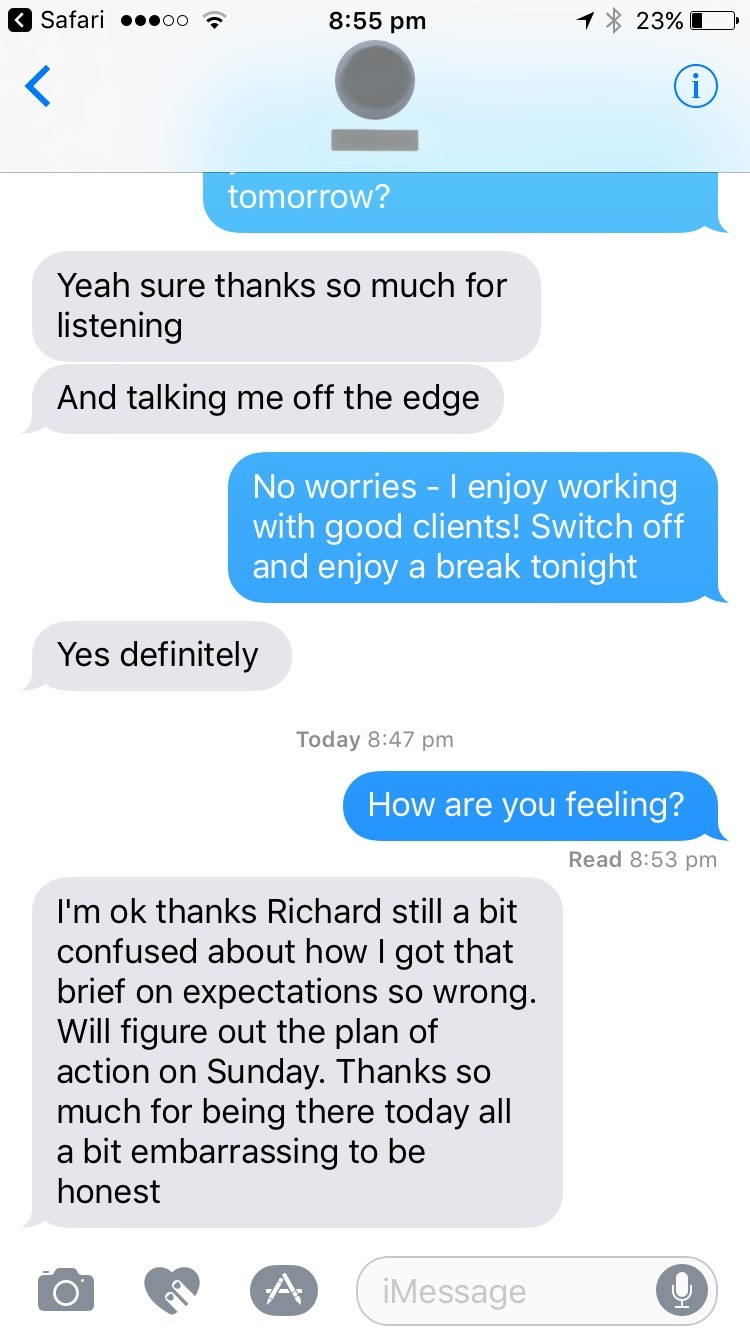
The text came at 8:53pm on a Thursday.

Mike ran public affairs at a major Australian energy company—twelve people, a serious remit. He’d spent weeks on a business case for a strategic initiative his team wanted to run, and he walked into the leadership meeting confident.

Instead of approval, he got an ambush. Why haven’t you delivered the other projects? How can you guarantee your team has the capability? Why is this the priority? Have you personally got the capacity?

The proposal was knocked back. The knock-back had little to do with the business case—the room had stopped trusting the function behind it. After 15 years in corporate affairs, Mike was being publicly questioned about his basic competence. That night, he sent the text.

So we went to work. In four weeks we cut about $550K of low-value work his team was drowning in—reports nobody read, briefings that took hours to draft—and moved them onto proactive stakeholder engagement, with metrics that connected the function to decisions his executives cared about.

Four weeks after the ambush, Mike presented his team’s transformation to the same room. At six weeks, the business case was approved. Six months on, the CEO publicly credited Mike’s ‘Voice of the Community’ program with de-risking a major project approval, and the CFO asked him to present his operating model to the other functions.

That’s the work we’re doing here.

Redacted text messages from Mike. That evening: ‘Thanks so much for listening. And talking me off the edge.’ Later, read at 8:53pm: ‘Thanks so much for being there today, all a bit embarrassing to be honest.’
Mike’s texts that evening. Name and photo redacted; nothing else changed.

Designed, drafted, and ready for the room.

By the end of the 90 days, three artefacts exist and are fit to use.

Your CA Operating Model, designed

How the function runs: what it stops, what it automates, what it owns, and how the work maps to the company’s top priorities.

Campaign plans, drafted

The priority work turned into campaigns with scope, owners, and milestones. I review them before they go live, so the work is sharper before it hits the business.

The ELT Endorsement Pack, ready

The storyline and recommendation you take to your executive leadership team. I review it before you walk into the room.

A weekly small-group call

Make decisions, pressure-test the model, and keep the work moving.

Working templates

So you’re not staring at a blank page trying to turn instinct into structure.

A private community

When you’re between calls and need a second set of eyes, you’re not sitting there alone trying to word the thing properly.

The CA Rhythm Library

Practical meeting rhythms, routines, and operating practices you plug in rather than invent.

First thing in your inbox

The Zombie Work Audit

A 20-minute scan of the work your team is doing that no one would miss if it disappeared tomorrow. The fastest capacity gain in most CA functions is finding the work that should have been killed two restructures ago.

A small room, deliberately senior.

The seat

You’re the Head of Corporate Affairs at an ASX-listed company, or close enough to own how the function runs.

The material

You have real priorities, a real team, and enough access to senior leaders to test the work as we build it.

The catch

You’re willing to stop doing some things. Which sounds easy until someone asks for the board paper format they’ve loved since 2014.

It’s a working build, run on your live priorities. There’s no comms curriculum in here, no lobbying playbook, and nothing that ends its life in a folder called ‘final final v7’.


$4,500 AUD, paid in full

If you’d prefer to spread it, it’s three monthly instalments of $1,800.

The guarantee

Show up and complete the work, and if within 90 days you don’t have your CA Operating Model designed, campaign plans drafted, and ELT Endorsement Pack ready for your executive leadership team, I keep working with you at no extra cost until you do.

I’m not guaranteeing your CEO suddenly writes poetry about corporate affairs value. I am guaranteeing the model, the campaign plans, and the endorsement pack will be ready to put in front of them.

Step 1

Message me ‘Operating Model’ on LinkedIn, or email the same two words. There’s no need to send money first.

Step 2

I’ll send you the offer doc and either the payment link, or a link to a 15-minute fit call if we need to check it.

Step 3

We get you set up before 3 August and start building the system.

The cohort is capped at seven, so the weekly calls stay working sessions. The first three people in also get a private Strategic Leader Session with me each month of the 90 days. After this one, the next cohort starts in October.

Seven places. We start 3 August.

Message me ‘Operating Model’ and I’ll send you the offer doc. No money first; if we need to check fit, we’ll have a 15-minute call. The first three people in also get a private Strategic Leader Session with me each month of the 90 days.